A Rolfers' Perspective
It is through the many forms of connective tissue, the elastic medium that connects every part of our body to every other part, that we take shape in the womb and grow throughout our lifetime. This network of fluids, delicate membranes, strong chords, bags, straps, and bubble wrap, forms the scaffolding for every cell, tissue, organ, and system of the body.
The various types of connective tissues all have in common two basic structural elements; collagen fibers and a fluid ground substance. The many variations of connective tissues are made possible by varying the arrangement and quantity of the fibers and by varying the size of the elements of the ground substance which is a mucopolysaccharide, a carbohydrate combined with a protein chain.
“We can regard these ground substances as both facilitators and as barriers between the blood and all the cellular surfaces, chemical filters which regulate many interactions. Damage to their elements through malnutrition, trauma, fatigue, stress, and the like results in the impairment of these supporting functions by the depletion of fluid volume, by the buildup of foreign particles and toxins, or by altering the chemical properties of the mucopolysaccharides. Such disruption strikes at the very basis of healthy metabolic activity. Healthy ground substance works constantly to help maintain a supportive chemical and physical equilibrium between all the body’s tissues.”
Reprinted with permission from “Job’s Body” by Deane Juhan
Connective tissue is the fibrous mesh that gives the skin both its pliability and tensile strength, and fixes it firmly to the layers and structures underneath. Deeper it separates muscles, tissues, and organs into separate compartments, binding everything firmly while still allowing for movement and growth.
“…it takes on many different shapes and properties, and has different qualities that differ widely from place to place. It can be quite diffuse and watery, or it can form a tough flexible network. In the tendons and ligaments its tensile strength is superior to steel wire, the cornea of the eye is as transparent as glass; it accounts for the toughness of leather, the tenacity of glue, the viscosity of gelatin. Invest it to various degrees to hyaline, a nylon like substance exuded by chondroblasts and it becomes the various grades of cartilage; invest it with mineral salts and it becomes bone.”
Reprinted with permission from “Job’s Body”, by Deane Juhan
The same properties that give connective tissue its’ tenacity can lead to movement inhibition after an injury and in mature and aging bodies. The collagen fibers do a great job of binding to each other and over time, especially in high stress areas of the body, this binding is compounded leading to less fluidity and limited range of movement. Moist, supple tissues can become sticky and stiff. Adjacent muscles can lose their ability to lengthen and contract independently of their neighbors. Movement limitations in one area affect other areas. Over time the ability of the body to maintain balanced posture and efficient movement is compromised.
Manual manipulation of connective tissues helps to restore lost resiliency. The squeezing and stretching breaks up the velcro like attachment of hydrogen bonds holding individual collagen fibers together. Individually these bonds are weak but the combined strength of millions of packed fibers is what we call scar tissue. Tissue manipulation also promotes the movement of the ground substance increasing the removal of toxins and the delivery of nutrients, hormones, and specialized cells like fibroblasts which create connective tissue. As normal range of motion begins to be restored, increased muscle movement allows for more fluid distribution and healthy tissue restoration.
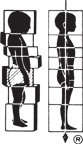
The ten session series is a template that Ida Rolf developed to be used as a both a guide for learning and as a treatment protocol. Imbedded in the ten series are principles for safely releasing limiting neuromuscular patterns in the body while encouraging overall reconnection and restructuring for the best possible outcome. These principles include beginning work at the surface to prepare for later core level work, supporting the entire structure from the bottom up, and working gradually, layer by layer, to release strong physical and cognitive patterns without creating a traumatic response. The goal is to leave each part of the body balanced and supported with the entire body aligned vertically within the field of gravity.
The connective tissue is involved in so many important functions of the body that it could be considered a major organ. It is with this understanding that the Rolfer places their hands on a body in an attempt to restore balance to a structure that expresses symptoms resulting from injury and overuse. With touch that listens and responds, slowly sinking through the surface layers to the foundation; entering a timeless space where the wholeness of the body waits to be restored.
